The clean-out did work. It cleared the standing water. What it did not do is turn off the taps, because excess refills through ordinary, everyday planning.
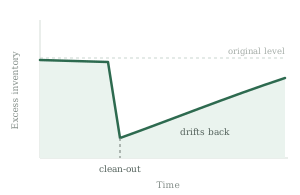
Three mechanisms drive the refill, and none of them looks like an error.
Safety buffers set to an older demand pattern. A buffer sized correctly two years ago stays in the system as demand shifts, and slowly becomes oversized.
A small positive bias in the forecast. A slight, consistent tendency to forecast a little high becomes ordering a little more, order after order.
Longer review cycles. As ranges grow, the cadence of revisiting stock parameters tends to stretch, so corrections arrive late.
Each is a reasonable default on its own. Together they refill the shelf about as fast as a clean-out empties it. That is why excess behaves like a recurring number rather than a one-off pile.
The implication is practical. Sustained reduction comes from adjusting the planning: re-sizing buffers to current demand, correcting the forecast bias, tightening the review cadence, not from a larger purge.