The trailing version is the default for good reasons. Actual sales are already in the system, they need no assumption, and they are the one input in the calculation that cannot be argued with in a meeting. A forward number invites the response that the forecast is wrong, which it partly is. So the trailing rate wins on availability and on defensibility, and the number gets reported without the basis being stated out loud.
It is worth looking at what the calculation is actually made of. The numerator is a present fact, counted today. The denominator is a past rate, measured over the last thirty, sixty or ninety days. The decision it feeds is entirely forward: whether to place an order, and for how much. Only the denominator is a choice, and it is the one part of the calculation that is looking the wrong way.
Take an illustrative case. Nine thousand units on hand. Last quarter sold at two hundred a day, so cover reads forty-five days, comfortably inside the reorder point. The plan for the coming quarter, which the same business wrote and signed off, is three hundred a day. Against that, the same nine thousand units is thirty days. Same stock, same day, two answers, and the ordering decision is different in each.
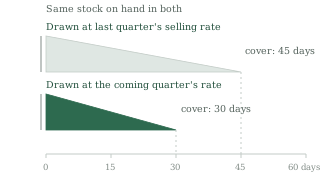
Which way the error runs depends on the direction demand is moving, and both directions cost something. When demand is growing, the trailing rate is too low, so cover reads longer than it really is. The reassurance is highest on exactly the items that are accelerating, which are usually the ones earning the most. The gap closes quietly, and it shows up as a stockout on a good seller rather than as a bad number on a report.
Coming off a season or a promotion, it runs the other way. The trailing window still holds the peak, the daily rate is inflated, and cover reads short against demand that has already turned down. That reads as a shortage, so the order goes in, and it arrives into a quarter that will not consume it. This is the more expensive direction, because the stock it creates is on items whose demand is falling, and it tends to be bought in size while the peak is still fresh in everyone's memory. Excess built this way is not a planning failure so much as a metric doing what it was asked.
The correction is not to replace one number with another. A forward view rests on a forecast, and a poor forecast is not automatically better than an honest trailing rate; swapping the denominator without saying so just moves the argument. What is worth doing is smaller. Compute cover both ways on the same stock, on the same day, and look at the gap. Where the two agree, the trailing number is safe to act on. Where they separate, the item is being planned against a demand path it has already left, and that list is usually short enough to work through by hand.
Two things make the gap wider than people expect. Long lead times, because the stock being ordered today lands in a period the trailing window has no view of at all. And any known one-off in the recent past, such as a campaign or a bulk order, which sits inside the trailing window and inflates the rate until it ages out. Both are ordinary and both are knowable in advance, which is what makes the gap worth measuring rather than worth worrying about.
None of this requires a new system. It requires the basis to be stated whenever the number is quoted. Forty-five days against what.